
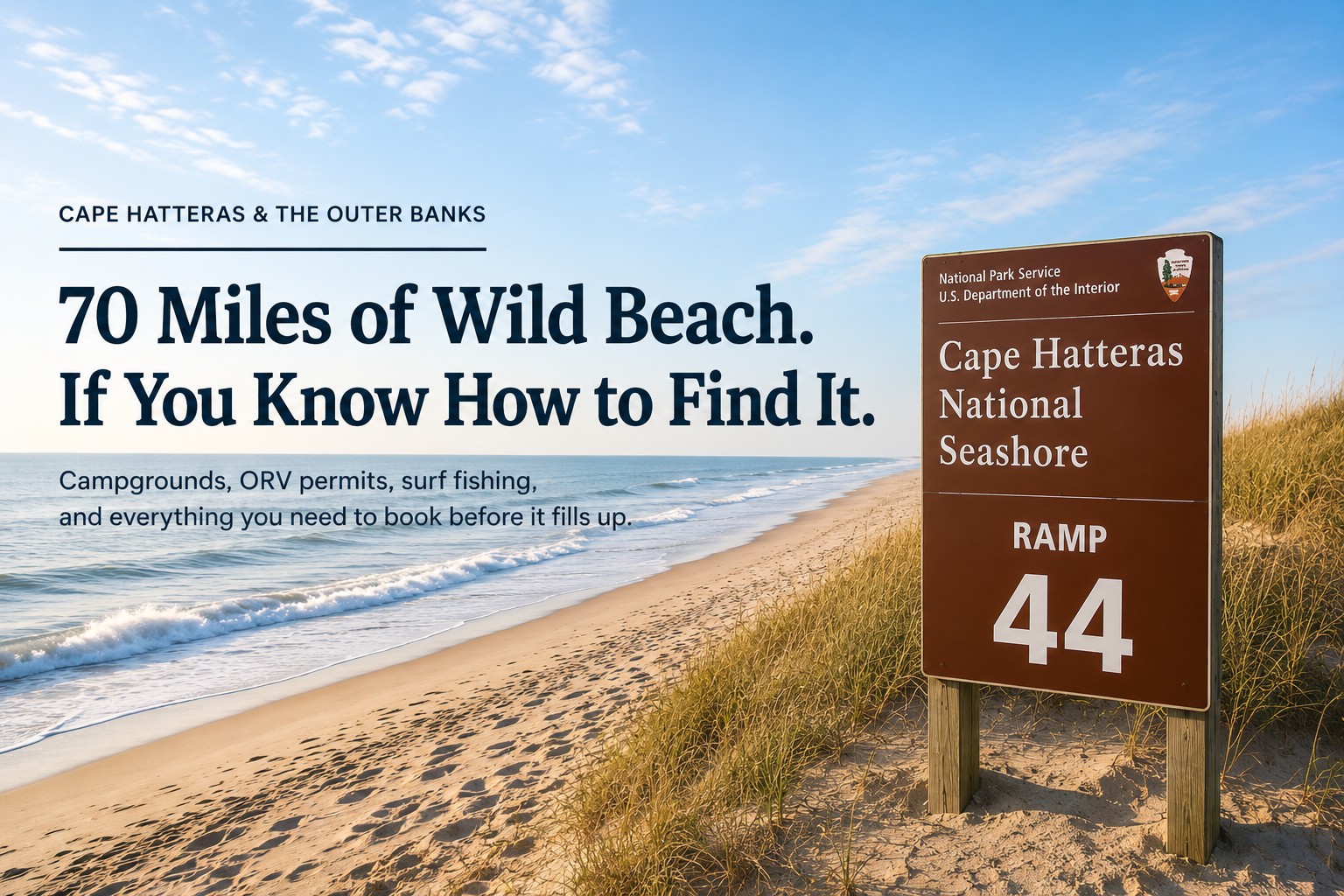
CAPE HATTERAS NATIONAL SEASHORE
Camping the Outer Banks: Cape Hatteras, Ocracoke, and the Real OBX Experience
Everything you need to plan a Cape Hatteras camping trip — campgrounds, ORV permits, beach driving, surf fishing, and what to know before you commit.
There’s a version of the Outer Banks that never makes the travel magazines.
No rental houses. No mini golf. No line outside the fish taco place.
Just miles of raw barrier island, wind coming off the Atlantic, and a beach wide enough that you can drive for miles without seeing another person.
If you have a four-wheel drive vehicle and a beach access permit, you can park near the surf, fish the point until sunset, and fall asleep with salt still in the air.
That version of the Outer Banks still exists. You just have to know where to look — and be willing to camp.
Quick Take
- Campgrounds: Oregon Inlet, Cape Point, Frisco, Ocracoke — all primitive, no hookups
- Booking: Recreation.gov, opens six months in advance — fills fast in summer
- ORV permits: Required for beach driving — verify current fee status at NPS before your trip
- Best for: Surf fishing, beach camping, 4WD access, serious OBX trips
- Skip it if: You need hookups, shade, or a campground store nearby
- Best time: Late September into October — fewer crowds, better fishing, no summer heat

QUICK PICKS
Best Outer Banks Campgrounds to Start With
Four campgrounds, four different trips. Match your style before you book.
BEST OVERALL
Cape Point Campground
The classic Cape Hatteras pick. Right at the point, direct beach driving access, and the best surf fishing location of any NPS campground on the seashore. Exposed and primitive — wind, sand, no shade. That’s the deal and it’s worth it.
Reserve on recreation.gov →BEST FOR RV TRAVELERS
Camp Hatteras RV Resort
A private campground, not NPS — which means hookups, amenities, a pool, and a campground store. Right on the beach in Waves. The right call if primitive camping isn’t the point and you want a comfortable base without the hassle.
Check Availability →BEST FIRST NPS CAMPGROUND
Oregon Inlet Campground
The most accessible NPS campground on the seashore — just south of Nags Head, easy to reach without the full Hatteras drive. Good fishing access, close to Bodie Island Lighthouse, and the easiest way to test Cape Hatteras camping before committing to something more remote.
Reserve on recreation.gov →MOST REMOTE FEEL
Ocracoke Campground
Ferry access only. Ocean on one side, sound on the other. The most isolated camping experience on the Outer Banks — no hookups, no nearby stores, no quick run back for anything you forgot. Plan before you board. Worth it for the right traveler.
Reserve on recreation.gov →THE REALITY CHECK
Is Cape Hatteras Camping Right for You?
Cape Hatteras camping isn’t the easiest Outer Banks trip. That’s part of the appeal.
The best sites book early. The wind can make a cheap tent useless. Bugs can be brutal in warmer months. Most NPS campgrounds have no hookups, limited shade, and very little protection from weather.
But if you want open beach, surf fishing, dark skies, and a slower version of the Outer Banks, this is one of the best places on the East Coast to find it.
BOOK EARLY OR MISS OUT
Reservations open on Recreation.gov exactly six months in advance. For a July 4th week, that window opens January 4th.
The best sites at Cape Point and Ocracoke are gone in minutes. Be logged in before the window opens and have your dates ready.

CAMPGROUND CHOOSER
Which Cape Hatteras Campground Should You Choose?
Each Cape Hatteras campground has a different feel. The right choice comes down to how much exposure, remoteness, and convenience you want.
MOST EXPOSED
Cape Point
Best for: Serious fishing, beach driving access, and the classic Cape Hatteras experience.
Wide open, fully exposed, and not forgiving if you’re underprepared. Pick this if you want the rawest National Seashore feel and you’re ready for wind, sand, sun, and very little protection.
View availability on Recreation.gov →BEST TENT OPTION
Frisco
Best for: More protection, easier tent setups, and a quieter base.
Still primitive, but usually a better choice for tent campers who want a little more shelter from the worst wind. Pick this if you want the National Seashore experience without going straight into the most exposed option.
View availability on Recreation.gov →MOST REMOTE
Ocracoke
Best for: Slower trips, quieter beaches, and the most disconnected island feel on the OBX.
It takes more effort to get there, but that’s part of the appeal. Ferry-only access keeps the crowds manageable. Pick this if you want distance and the most removed version of Outer Banks camping.
View availability on Recreation.gov →EASIEST ACCESS
Oregon Inlet
Best for: First-timers, fishing access, and easier logistics.
A simpler entry point if you want the Cape Hatteras experience without going fully remote. Just south of Nags Head, close to Bodie Island Lighthouse, and a softer first step into National Seashore camping.
View availability on Recreation.gov →WHAT NOBODY TELLS YOU: BUGS
- Mosquitoes and no-see-ums come out hard at dawn and dusk.
- The sound side is often worse than the ocean side.
- Even shoulder season can still be brutal.
- Pack serious bug spray. It’s not optional.
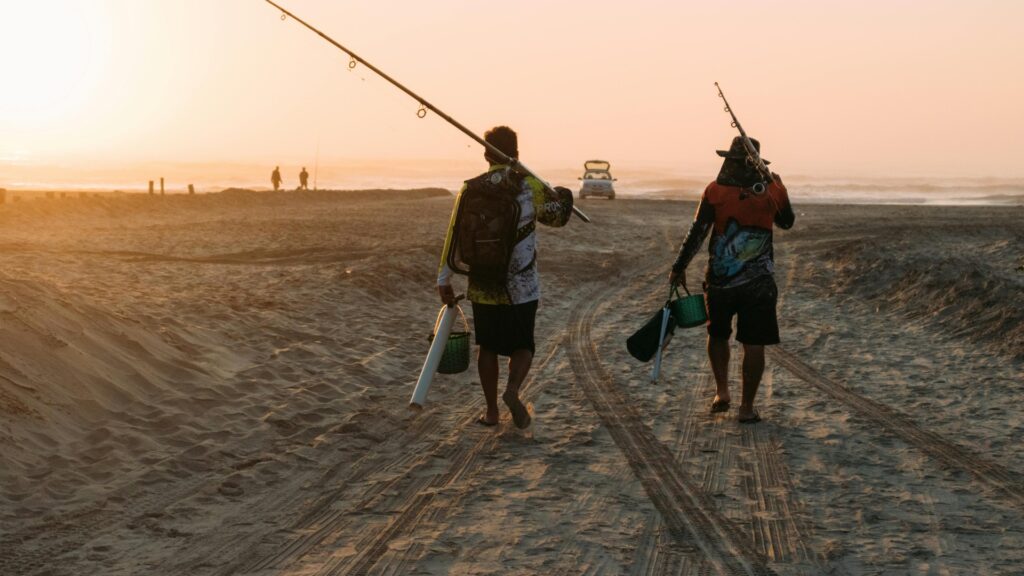
PRIVATE CAMPGROUNDS
More Comfort, Less Hassle
The National Seashore campgrounds are the main event, but they’re primitive, competitive, and not the right fit for every traveler. These private campgrounds trade some of the raw OBX feel for hookups, amenities, and easier logistics.
None of them feel as wild as the National Seashore sites. That’s the point.
BEST FOR FAMILIES
Cape Hatteras KOA Resort
The KOA in Rodanthe is the most full-featured campground on Hatteras Island. Oceanfront access, full hookups, a pool, camp store, and cabins make this the easiest version of OBX camping. It’s not the wild National Seashore experience — it’s a campground resort, and for families or larger RV setups, that’s often the better call.
Visit Cape Hatteras KOA →BEST SOUND-SIDE FEEL
Frisco Woods Campground
Frisco Woods sits on the sound side, which completely changes the feel of the trip. Calmer, more protected from wind, and a better fit if you want sunsets, kayaking, and slower evenings. Tent sites, cabins, and RV hookups all available. This is the campground for people who want Hatteras Island without the full punishment of beach camping.
Visit Frisco Woods Campground →BEST FOR OCRACOKE ACCESS
Hatteras Sands Camping Resort
Hatteras Sands makes the most sense if Ocracoke is part of your plan but you don’t want to move your entire camp setup across the ferry. Located in Hatteras Village near the ferry docks — hookups, cabins, pool, laundry, and easy access to the island without the commitment of camping there.
Visit Hatteras Sands →BEST FOR CHARTER FISHING
Oregon Inlet Fishing Center Campground
This campground exists for one reason: fishing. Located beside one of the most productive marinas on the East Coast, it’s the right call if your trip revolves around offshore charters, tournaments, or early mornings at the dock. Don’t expect resort amenities. Expect coolers, tackle, and quick marina access.
Visit Oregon Inlet Fishing Center →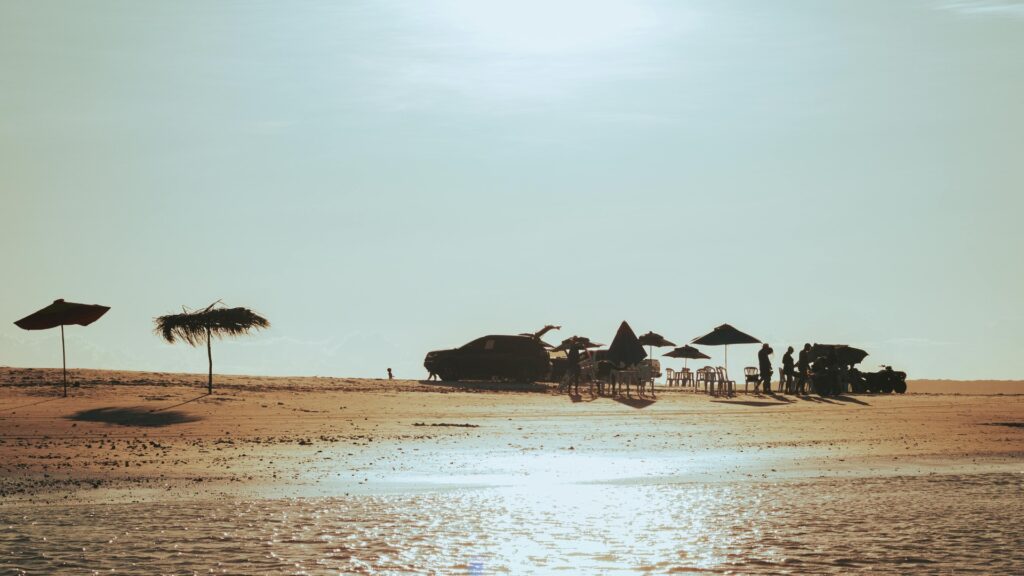
OFF-ROAD DRIVING
Driving on the Beach at Cape Hatteras
Beach driving is one of the best parts of the Outer Banks experience. It’s also the fastest way to ruin your trip if you’re not prepared.
The sand isn’t difficult once you understand it. The problem is overconfidence. People get stuck every single day on Cape Hatteras, including experienced drivers.
READ THIS FIRST
If your tires start spinning, stop immediately. Most recoveries get worse because drivers panic and floor it. That turns a small problem into buried axles and a tow bill.
You Need Real 4WD
AWD is not the same thing as 4WD on Cape Hatteras sand.
You need a true four-wheel-drive vehicle with low range capability. Crossovers and soft-road systems struggle quickly once conditions soften or ruts deepen.
If you’re unsure whether your vehicle qualifies, assume it doesn’t. Park at the access ramp and walk instead.
Works well
Trucks, body-on-frame SUVs, true 4WD systems.
Usually struggles
AWD crossovers and street-focused SUVs.
Most common mistake
Thinking “sand mode” replaces low range.
Reality check
The tow trucks stay busy for a reason.
Air Down Before You Hit the Sand
Lower tire pressure is the single biggest difference between floating across the sand and digging yourself in.
Most experienced drivers air down before every beach run, even in good conditions.
Target PSI
15 to 20 PSI works for most vehicles.
NPS guidance
Under 20 PSI is strongly recommended.
Soft sand
Lower pressure may still be necessary.
Before pavement
Air back up before highway driving.
LOCAL TIP
Most ramps have nearby businesses with air stations and compressors. Know where you’re airing back up before you leave the beach.
How to Drive on OBX Sand
Beach driving is mostly about staying smooth and avoiding panic decisions.
Drive steady
No hard acceleration or sudden turns.
Use existing tracks
Firm sand is usually already marked.
Avoid stopping
Soft sand is where vehicles sink fast.
Watch the tide
Incoming water changes conditions quickly.
Required Recovery Gear
NPS ORV routes require basic recovery equipment in your vehicle. Rangers do check.
Tire gauge
Low-pressure gauge for airing down.
Shovel
Essential if you get buried in soft sand.
Jack
Needed for tire issues and recovery.
Jack board
Keeps the jack from sinking into sand.
What Experienced Drivers Always Bring
Portable compressor
Much faster than waiting at crowded pumps.
Tow strap
Recovery is easier when another truck is nearby.
Traction boards
Useful for self-recovery in soft conditions.
Undercarriage wash
Salt and sand destroy vehicles over time.
THE HONEST REALITY
You air down at the ramp, shift into 4-low, and roll onto the beach. The ride changes immediately. Slower. Softer. More deliberate.
You keep driving until the crowds disappear. Then you stop, set up near the water, and realize there aren’t many places left on the East Coast that still feel like this.
That’s why people keep coming back.
KNOW BEFORE YOU GO
Seasonal Closures and Wildlife Protection
This is the part many first-time visitors overlook. Sections of the ORV routes close seasonally, and sometimes the exact area you planned to drive or fish is unavailable.
Always check current access conditions before you leave for Cape Hatteras. Not the week before. Not when you booked the trip.
CLOSURE ALERT
Most wildlife-related closures happen between April 15 and October 14, but the affected ramps and shoreline sections change throughout the season.
Cape Point, one of the most popular surf fishing areas on the entire Outer Banks, is frequently impacted.
For real-time ORV alerts, text CAHAORV to 333111.
Why the Closures Exist
Cape Hatteras isn’t just a beach destination. It’s one of the most important wildlife nesting areas on the East Coast.
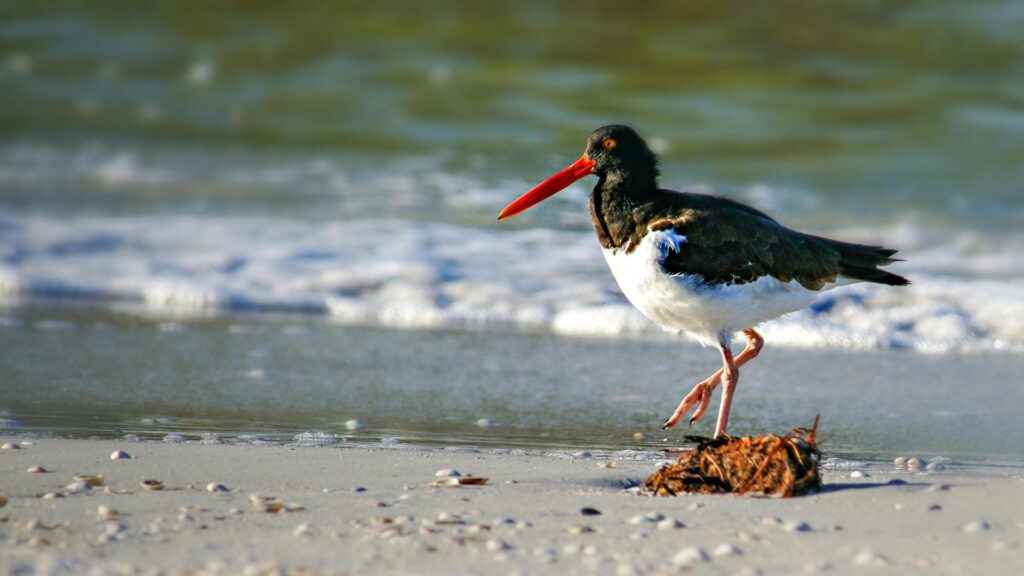
Piping plovers nest directly on open sand. Sea turtles bury eggs above the tide line. American oystercatchers work the same shoreline people drive and fish every day.
These aren’t abstract conservation policies. Without them, some of these species disappear from the Outer Banks entirely.
Piping plovers
Federally threatened shorebirds that nest directly on the beach.
American oystercatchers
Large black-and-white shorebirds with bright orange bills.
Sea turtles
Nesting activity increases heavily during warmer months.
Protected habitat
Temporary closures help prevent nest disturbance and vehicle strikes.
LOCAL PERSPECTIVE
If you grew up visiting the Outer Banks, you probably remember seeing oystercatchers constantly along the shoreline. They’re still here, but nesting populations remain fragile across Cape Hatteras National Seashore.
What to Do When You Encounter a Closure
Respect barriers
Don’t drive around fences or marked closures.
Give birds distance
Nesting areas are often difficult to see from a vehicle.
Check ramp status
Conditions and access points change throughout the season.
Use text alerts
CAHAORV alerts are the fastest way to track closures.
If you care enough about Cape Hatteras to make the drive, spend five minutes checking current conditions before you head onto the beach. It’s worth it.
PACKING LIST
What You Need for Outer Banks Beach Camping
Beach camping on the Outer Banks is different from a standard campground trip. Wind, sand, bugs, sun, and limited services change what actually matters.
SHELTER
Plan for Wind First
You need a tent, RV setup, or shade system that can handle open coastal exposure. Cheap stakes and flimsy canopies don’t last long out here.
Shop sand stakes →POWER
Bring Backup Power
Some sites are primitive, and even electric sites feel limited fast once phones, lights, fans, and small gear enter the picture.
Shop power stations →SUN & BUGS
Protect Yourself Early
Sun, mosquitoes, no-see-ums, and wind exposure wear people down fast. Bring more sunscreen, bug spray, and shade than you think you need.
Shop bug spray and sunscreen →FOOD & WATER
Stock Before You Arrive
Don’t count on quick grocery runs once you’re deep on Hatteras or headed to Ocracoke. Bring a serious cooler, extra water, and meals you don’t have to think about.
Shop camping coolers →REALITY CHECK
If your setup can’t handle wind and sand, the trip gets harder fast. Plan for exposure first. Comfort comes after that.
BOOKING STRATEGY
How to Actually Get a Cape Hatteras Campsite
Cape Hatteras camping isn’t casual booking. The best National Seashore sites go fast, especially at Cape Point, Ocracoke, and Oregon Inlet.
If you treat this like a normal campground reservation, you’ll probably end up using a private campground as your backup plan.
NPS campgrounds
Reservations open six months in advance on Recreation.gov.
Move fast
Be logged in with dates ready before the booking window opens.
Have backups
Know your second and third choice before you start booking.
Watch cancellations
Good sites reopen, especially one to two weeks before arrival.
BOOKING TIMELINE
NPS sites open exactly six months out — be logged in and ready when that window hits. For holiday weeks and fall fishing dates, don’t browse. Pick your site and confirm. Private campgrounds are more forgiving, but peak summer still fills early. Book three to four months out to be safe.
The play is simple: go for the National Seashore site first, have a private campground in mind as backup, and check for cancellations in the week or two before your trip. Good sites do come back.
FAQ
Common Questions About Cape Hatteras Camping
Do you need reservations for Cape Hatteras campgrounds?
Yes. National Seashore campgrounds book through Recreation.gov with a six-month reservation window. Popular dates at Cape Point and Ocracoke disappear fast, especially in summer and peak fishing season.
What’s the best campground on Cape Hatteras?
Depends on your trip. Cape Point is the most iconic and best for surf fishing. Frisco is easier for families and tent camping. Ocracoke is the quietest and most remote. Oregon Inlet is the easiest first-time option.
When’s the best time to camp the Outer Banks?
Late September through October. Cooler weather, fewer crowds, fewer bugs, and better fishing. Fall is when a lot of experienced OBX campers make their annual trip.
Are the bugs really that bad?
Yes. Mosquitoes and no-see-ums are part of the experience, especially near the sound side and around dawn or dusk. Bring strong repellent and don’t assume shoulder season gets you off the hook.
Do you need 4WD to camp at Cape Hatteras?
Not for the campgrounds themselves — any vehicle can access campground roads. But beach driving requires true 4WD with low range capability. AWD isn’t the same thing out here.
Do you need an ORV permit to drive on the beach?
Yes. Any vehicle using designated ORV routes inside Cape Hatteras National Seashore needs a permit through Recreation.gov. Verify current requirements before your trip — details can change seasonally.
Is Ocracoke worth the extra effort?
Yes, if you want quieter beaches and fewer people. The ferry crossing is part of what keeps it that way — it filters out anyone who isn’t committed to being there.
Are there campgrounds with hookups?
Most National Seashore campgrounds are primitive or limited-service. For full hookups, pools, and resort amenities, look at private options like the Cape Hatteras KOA or Frisco Woods.
Can you camp directly on the beach?
No. Overnight camping on the sand isn’t allowed. All camping is restricted to designated campground areas within the National Seashore.
Do you need a fishing license on the Outer Banks?
Yes. A North Carolina Coastal Recreational Fishing License is required for most surf fishing and coastal fishing activity. Pick one up before you arrive.
How far ahead should you book?
For National Seashore campgrounds, book the moment the six-month window opens. For private campgrounds, three to four months ahead is the safe play for peak summer dates.
KEEP EXPLORING
More OBX Guides

Some links in this guide are affiliate links. If you book through them, we may earn a small commission at no additional cost to you. We only recommend places we’d actually send someone.